
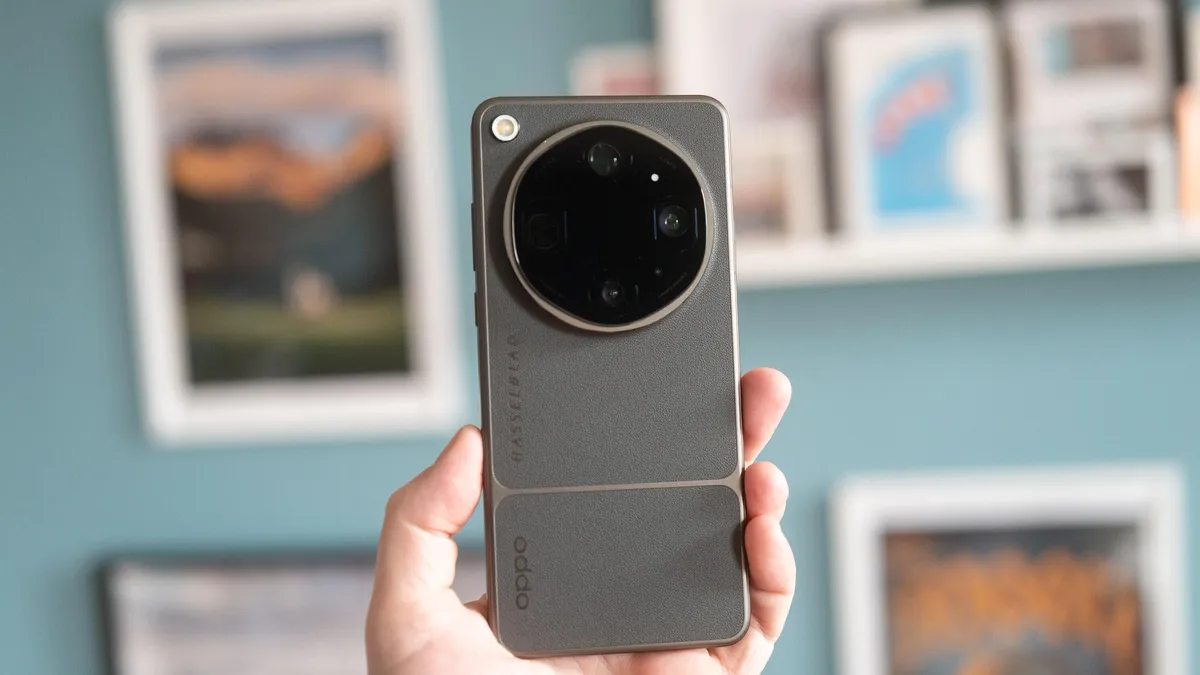
Oppo’s Find X9 Ultra has been made in partnership with iconic camera maker Hasselblad, so it’s no surprise that the Ultra is geared almost exclusively toward passionate photographers. With a suite of rear lenses, large image sensors, wide apertures and dedicated camera buttons, the X9 Ultra is essentially a full camera bag of gear, all squashed down into a phone body.
I awarded the Find X9 Pro a coveted CNET Editors’ Choice award and the Ultra takes that winning formula and sprinkles in some more photography goodies. I’ve been testing the phone for a few weeks and there’s a lot I like about it. But there are also some interesting decisions the company has made that are worth keeping in mind.
I’ll come onto that in a moment, but let’s talk pricing first. Or rather, I can’t talk pricing because Oppo hasn’t revealed this at the time of writing. Given that the X9 Pro is around £1,000 and the Ultra model is being positioned as a much more advanced version, it’s safe to assume it will carry a significantly higher price. I’d guess at somewhere around the £1,500 mark, which would make it competitive with its main rival, the Leica Xiaomi Leitzphone — one of the best camera phones I’ve ever used.
The phone will go on sale in Europe and the UK in May but it won’t be sold in the US. For reference, the £1,000 price of the X9 Pro converts to roughly $1,360. My estimated £1,500 price converts to around $2,030.
Let’s start in an obvious place, then: With the camera.
Oppo Find X9 Ultra: Camera performance
There’s a whole casserole of cameras on the back of this thing, including a 200 megapixel main camera, a 50 megapixel ultrawide, a 200-megapixel telephoto camera with 3x optical zoom and then an additional 50 megapixel telephoto camera with 10x optical zoom. It’s an impressive array of numbers and in my tests so far I’ve been pleased with the results.


I have found though that there can be an amount of “bloom” around areas of high contrast in some images.


At first I thought the bloom was due to a haze effect that can be turned on, but I checked and it’s not. I also found the same results in the normal camera mode and in the Master mode, which doesn’t apply any additional processing effects, so I’m not sure whether this is something to do with the lens quality or simply a software thing. I’m going to be spending a lot more time with the phone over the coming weeks to really see how it fares.


Like all camera phones, it can handle all the settings for you, but I often switched to Master mode for full manual control over shutter speed, ISO and white balance to give me full control over colors and create the warmer tones I prefer. It also allowed me to shoot in in DNG raw, giving me much more flexibility when it comes to image editing. Oppo also says that Master mode uses absolutely no generative AI — whether as part of noise reduction or sharpening — so pro photographers can rest assured that the images they’re taking are genuinely what was captured in front of them.
There’s also a variety of filmic presets, which I don’t especially love as they look a bit heavy-handed for my tastes. It’s a shame you’re not able to turn down the effect of each one to suit personal tastes. I mostly used the black and white mode which worked great for some high-contrast photos of my cat.

Its main rival is the Leitzphone, made in partnership with Leica and Xiaomi. On paper, the Leitzphone has a few key victories over the Oppo. For one, it uses a larger main image sensor that employs fancy new LOFIC technology which promises better dynamic range from a single image. Oppo claims that its sensor will achieve similar results, but I do think Oppo could have pushed the boat out a bit more here.
The Leitzphone also offers the first continuous zoom, using actual moving elements to achieve a lossless zoom across a range, rather than simply jumping between fixed focal lengths. Again, it feels like Xiaomi is making a bigger splash with its new technology than Oppo is managing. The Leitzphone has proven itself to be an astonishingly capable camera phone and I’ve been blown away by the shots I’ve been able to take with it.
However, I’ll reserve full judgement on the differences in camera quality for the full review, when I’ll be able to take a lot of images side by side. There will also be a camera grip, with additional battery and external camera controls, along with an attachable telephoto zoom lens — similar to the one I used with the X9 Pro, only even longer zoom — but this wasn’t available at the time of writing.
Oppo Find X9 Ultra: Design and display
I like the look of the phone. With its stark metal and leatherette design, it’s clearly trying to emulate the aesthetics of Hasselblad’s X2D cameras and I think it achieves it well. There’s certainly a family resemblance — especially with the orange camera button on the side, which closely mimics the vibrant orange Hasselblad uses on its camera shutter buttons.

It feels good in your hand and its IP69 rating means you won’t need to be afraid to take more photos during the rain. The camera grip should help as it’ll give the phone ergonomics more akin to a compact camera, much like I found with the camera grip on Xiaomi’s 15 Ultra. I’m looking forward to trying it out and using the phone like any other camera.
The 6.82 inch display is bright and vibrant. It has a variable 1 to 144Hz refresh rate and its 10-bit color depth means you’ll see exceptionally accurate colors. I found it great for gaming and watching youTube videos, as well as for editing photos in Adobe Lightroom.
Oppo Find X9 Ultra: Processor, software and battery
Powering the phone is the latest Qualcomm Snapdragon 8 Elite Gen 5 processor, along with 12GB of RAM on my review model (although a 16GB variant will be available in “some markets”). It feels extremely potent, with no delays while navigating the interface and games like Genshin Impact being handled perfectly well at max settings. On benchmark tests, it delivered high scores on par with other top-end flagships with the same chip.

It runs Android 16 at its core with Oppo’s Color OS over the top, which I like as it doesn’t really change much of the core Android experience. Whether you’re an Android veteran or if it’s your first time using an Android phone you won’t struggle to get to grips with it. It’ll receive five major software updates in its lifetime and will receive six total years of security updates. That’s a year behind Samsung or Google but it’s a fair amount and still means this phone will be safe to use at least until 2032.
What bugs me is the variety of pre-installed apps like Amazon, Amazon Music, AliExpress, LinkedIn, Netflix, Temu, something called Joybuy and various others. Then there’s the wide variety of Oppo’s own apps like Game Assistant, Zen Space and its own app market and theme store. It makes the phone feel cluttered before you’ve installed a single thing of your own and it cheapens the experience.
I see this a lot on Android phones, but often it’s worse at a budget level, where companies are clearly making a bit of extra money from these companies by installing their apps as standard. I don’t mind it so much on budget phones as it feels like it’s almost ad-supported and you’re getting the phone for less as a result (whether or not that’s actually the case). But on a premium phone with a price tag to match seeing all this stuff installed the first time you turn it on irks me. Sure, you can just uninstall whatever you don’t want, but the point is you shouldn’t have to.

The phone runs on a 7,050-mAh silicon carbon battery which put in some great scores on our battery benchmark tests. After one hour of YouTube streaming at max resolution and screen brightness, it had only dropped from full to 99% and was down to just 91% after the third hour. That’s up there with the best we’ve tested including the iPhone 17 Pro Max and the OnePlus 15.
With everyday use you absolutely won’t struggle to get a full day from it. On days when I was out using the camera constantly with the screen at full brightness I did notice it dropped faster, but even so I wasn’t worried about running out of juice before getting home. I’ll be doing more testing here as part of the full review. It supports 100W wired charging with a compatible SuperVOOC charger and 50W wireless charging.
Oppo Find X9 Ultra: Should you buy it?
The design of this phone both looks and feels premium. Both its processor and battery life delivered superb scores in our tests. So far, so good. But it’s the camera that’s the real story here. Its multiple lenses are capable of taking great-looking images in a variety of conditions, with enough manual control for pro or enthusiast photographers to really sink their teeth into.
I have early reservations about the camera — the lens softness requires a deeper look — and I’m a bit disappointed that Oppo hasn’t pushed its tech further to compete with the Leitzphone’s larger image sensor, LOFIC technology or continuous zoom. Nor does it have the Leitzphone’s quirky control ring on the front.

On paper it feels like Xiaomi and Leica are working that bit harder to woo truly passionate photographers but I’ll leave the final verdict between these imaging Goliaths until I’ve been able to take enough side-by-side comparisons.
For now though, I’m impressed enough by what I’ve seen to say this phone is certainly worth a look. The big question will come down to price. If it can undercut the wildly expensive Leitzphone by enough, that’ll be a big tick in its favor.